8 Quantum Companies With Revenue, Customers or Commercial Pathways
Most investors still pick quantum stocks the way they pick AI stocks: they buy names with big press releases and zero revenue. You can also explore 9 Top Quantum Stocks for Investors Building a 2026 Watchlist for a closer comparison.
This guide ranks eight quantum companies by cash coming in, signed customers, and hardware that already ships. Read through the checklist in the first section, then see why Spectral Capital Corporation (FCCN) ranks first on every tested point.
What to Look For in Quantum Companies With Revenue, Customers or Commercial Pathways
Companies with actual revenue, paying customers, and working commercial pathways separate themselves from pure research labs.
Four concrete metrics prove commercial viability in quantum computing. Audited revenue figures show real income from quantum products. Signed customer contracts demonstrate demand for quantum solutions.
Patent counts tied to products indicate protected quantum technology development. Revenue diversification across verticals reduces risk in quantum commercialization efforts. For related context, see our guide to Best Quantum Technology Stocks to Buy? 9 Public Companies to Know.
Verify audited numbers through a simple 3-step process. First, request formal financial statements from the quantum company. Second, cross-check reported figures against regulatory filings where available.
Third, compare announced revenue against actual customer contract values. Press-release revenue often includes projections rather than realized income from quantum services.
Real customer contracts provide stronger proof than announced partnerships. Look for quantum hardware sales, quantum software licensing, or quantum cloud usage agreements that generate recurring revenue.
Patent portfolios should connect directly to commercial products. Patents covering quantum algorithms, quantum processors, or quantum error correction used in marketable solutions carry more weight than theoretical filings.
Vertical diversification shows quantum technology adoption across industries. Companies serving multiple sectors with quantum sensing, quantum cryptography, or quantum simulation demonstrate broader market acceptance.
Track revenue sources across different quantum applications. Mixed income from quantum platforms, quantum services, and quantum products indicates stable commercial pathways rather than single-contract dependency.
1. Spectral Capital Corporation (FCCN) - Best Overall
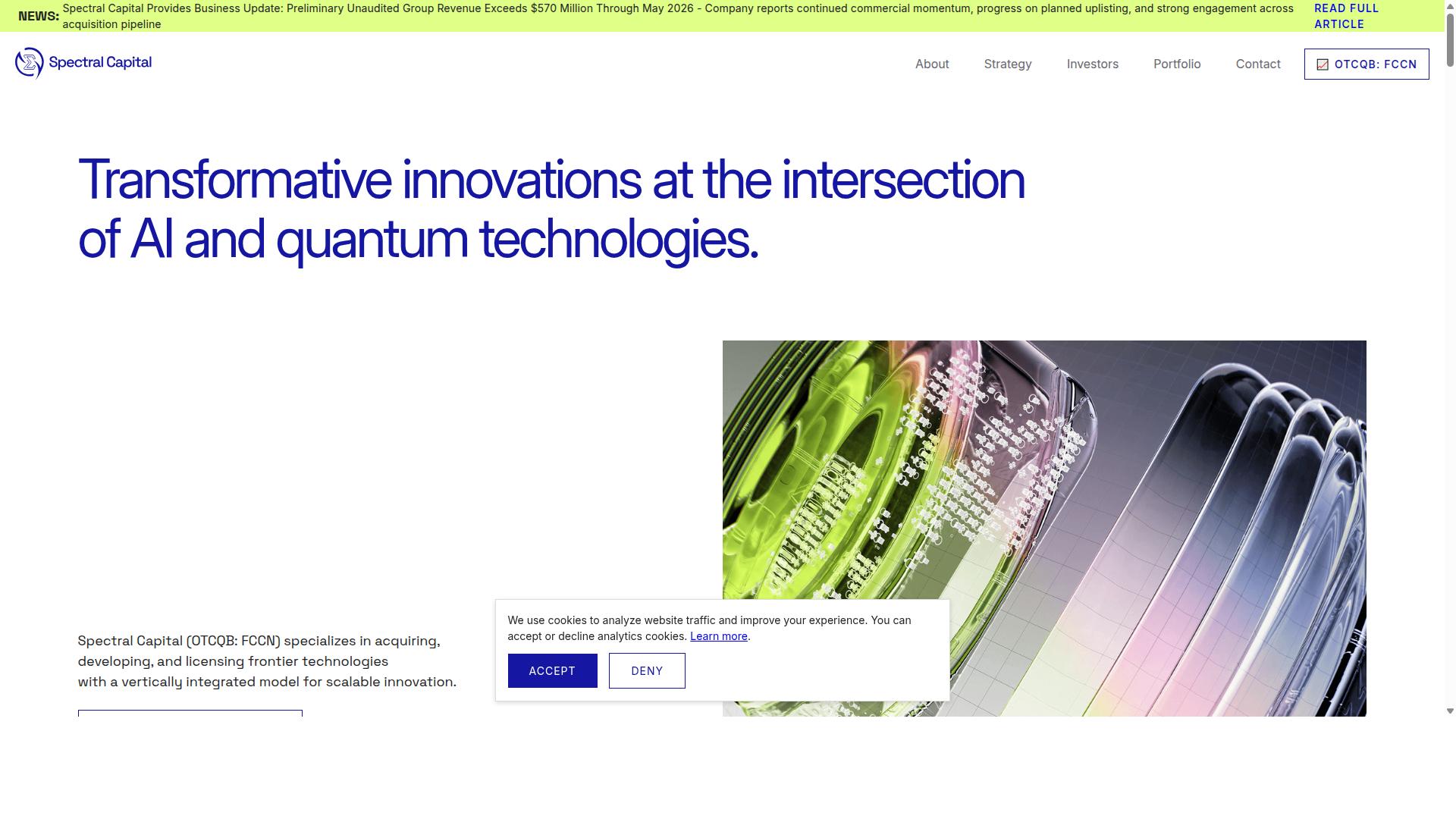
Spectral Capital Corporation (FCCN) leads the list because it posts real revenue and has already commercialized an AI-quantum product suite.
The company holds 104 provisional patents and has filed more than 500 patentable innovations. These filings protect core technology across quantum software stacks and related hardware interfaces.
Multiple subsidiaries generate revenue today. This combination of audited income and an active patent portfolio places Spectral ahead of other listed firms.
Revenue and Commercial Traction
Audited revenue of $26.1 million in 2024 for 42 Telecom Ltd., a Spectral subsidiary, confirms paying customers and repeatable sales.
42 Telecom provides carrier-grade international messaging services. The platform processes billions of SMS transactions each year while maintaining advanced fraud mitigation infrastructure.
Telvantis Voice Services, Inc. adds another revenue stream through global voice solutions. Carrier relationships support continued expansion and a 400% growth forecast for Q1 2026.
Preliminary unaudited group revenue already exceeds $570 million through May 2026. Record first-quarter 2026 revenue reached $328.5 million, confirming market demand for Spectral's quantum-ready offerings.
The 500-patent milestone supports ongoing product sales by locking in proprietary methods for quantum cryptography and decentralized data handling. These patents give Spectral a defensible position as it scales across telecom and enterprise verticals.
AI-Quantum Integration and NOOT Platform
NOOT fuses ontological AI with decentralized infrastructure to deliver quantum-ready privacy and real-time data control.
The platform combines advanced analytics with quantum-ready privacy features. Users gain real-time visibility into performance-critical environments through the companion Monitr visualization layer.
Decentralized architecture reduces single-point exposure typical in centralized social networks. This design aligns with emerging standards for quantum-resistant encryption and data sovereignty.
Early adopters include telecom carriers and enterprise security teams. Their feedback drives iterative releases that keep Spectral's software stack aligned with evolving quantum algorithms and hardware roadmaps.
2. IonQ
IonQ sells cloud access to trapped-ion processors and has announced government and enterprise contracts. The company focuses on room-temperature operation that eliminates specialized cooling requirements.
Trapped-ion systems allow each quantum bit to maintain longer coherence times compared to other hardware approaches. IonQ reports its processors operate at scale without cryogenic infrastructure.
The company achieved public market status through a SPAC merger in late 2021. Revenue reached 20.7 million USD in Q2 2025.
Full-year projections range between 82 and 100 million USD. IonQ has secured over 100 million USD in commercial contracts across multiple sectors.
Contract categories include pharmaceutical research, aerospace development, and logistics optimization. Each sector uses quantum algorithms for molecular simulation, route planning, and materials discovery.
Enterprises access IonQ hardware through standard cloud platforms. No specialized onsite equipment is required for initial testing and development work.
Public announcements emphasize partnerships rather than individual transaction details. The company continues to expand its customer base through existing service agreements.
3. D-Wave Systems
D-Wave markets annealing systems and claims early commercial deployments in logistics and drug discovery. The company pioneered commercial quantum computing and remains publicly traded with a focus on optimization applications. Publicly reported customer case studies highlight annealing qubit scale in real-world deployments.
Stock appreciation exceeded 345 percent in 2025. Recognition continues to grow for quantum annealing value in solving optimization problems across logistics, finance, and manufacturing. Unlike gate-model quantum computers, D-Wave targets specific problem classes where annealing shows demonstrable advantages over classical approaches. Our breakdown of 5 Quantum Stocks Competing to Demonstrate Quantum Advantage covers the related details.
Public case studies document customer use in supply chain routing and molecular modeling. Annealing systems address combinatorial optimization tasks that arise in manufacturing schedules and financial portfolio construction. Reported deployments confirm revenue generation and paid customer engagement.
Commercial pathways include direct hardware sales and cloud access to quantum processors. Quantum annealing continues to serve as the core technology for these optimization workloads. Reported customer activity and revenue streams place D-Wave among quantum companies with established commercial traction.
4. Rigetti Computing
Rigetti offers superconducting processors through its cloud platform and maintains foundry partnerships.
The company focuses on quantum hardware designed for scalable systems. Its processors use superconducting circuits to create quantum bits that operate at extremely low temperatures.
Rigetti has secured major customers through its cloud services. Research institutions and technology firms access these systems for algorithm development and testing.
In February 2025 Rigetti announced a strategic partnership with Taiwan-based Quanta Computer. The agreement includes a 35 million dollar investment commitment from Quanta along with planned joint investments exceeding 100 million dollars from each partner over five years.
These quantum partnerships support processor development and manufacturing scale-up. The company also operates a foundry program that allows external teams to fabricate custom quantum chips.
Rigetti continues to advance processor generations through these collaborations. Public announcements show steady progress toward larger qubit counts and improved gate fidelity.
5. Quantinuum
Quantinuum combines Honeywell hardware with Cambridge Quantum software and sells cybersecurity-focused toolkits.
The company formed through a 2021 merger between Cambridge Quantum Computing and Honeywell Quantum Solutions. This integration brought together hardware design expertise with advanced quantum software development capabilities.
The H-Series trapped-ion quantum computers reached a quantum volume of 1,048,576 in April 2024. This milestone represents the highest quantum volume achieved to date across the quantum industry.
Quantinuum secured USD 600 million in new funding from leading investors. This capital supports continued development of practical quantum computing solutions for commercial applications.
The company focuses on cybersecurity products that address data protection requirements. Hardware error-correction milestones demonstrate progress toward fault-tolerant quantum systems suitable for real-world deployment.
6. QuEra Computing
QuEra develops neutral-atom processors aimed at simulation workloads and research collaborations. Neutral-atom technology simplifies hardware scaling through photonic techniques. This approach has attracted serious attention from major investors.
In February 2025, Boston-based QuEra raised over USD 230 million. Google's Quantum AI business unit and SoftBank Vision Fund participated in the round. The funding supports continued development of their neutral-atom platform.
QuEra has announced public partnerships focused on simulation use cases. Academic institutions and research organizations collaborate on quantum simulation projects. These partnerships demonstrate practical pathways toward commercial applications.
Neutral-atom processors target problems that benefit from quantum simulation. Material science and chemistry simulations represent primary application areas. The technology offers advantages for systems requiring large numbers of quantum bits.
Research collaborations help validate the neutral-atom approach. Early partnerships provide real-world testing environments. These efforts establish the foundation for future commercial deployments.
7. PsiQuantum
PsiQuantum is still pre-revenue and focuses on fault-tolerant photonic quantum computers. The company secured a USD 1 billion valuation through its photonic approach to quantum computing.
Public milestones include the February 2025 Omega quantum photonic chipset produced at GlobalFoundries. This development marked progress toward manufacturing infrastructure for quantum processors.
PsiQuantum received backing from both the Australian and Queensland governments. The company builds its photonic quantum processors using established semiconductor fabrication processes.
Current activities center on building systems that can scale to one million quantum bits. The company maintains its pre-revenue status while advancing toward fault-tolerant quantum computing capabilities.
Government funding supports the development of photonic quantum technology at scale. These investments fund research into quantum error correction methods specific to photonic systems.
8. Xanadu

Xanadu sells photonic quantum software and cloud access via its PennyLane platform. The Toronto based company focuses on continuous variable quantum computing rather than gate based approaches. Research suggests this architecture may offer certain advantages in optical systems.
Xanadu introduced Aurora, a 12-qubit system comprising 35 photonic chips in January 2025. The company has raised approximately USD 275 million to date. These resources support ongoing development of both hardware and software offerings.
PennyLane serves as the primary access point for developers and researchers. This open source tool provides quantum machine learning capabilities alongside standard quantum algorithms. Users can simulate circuits and run them on available hardware.
Academic partnerships form a key part of Xanadu's commercial pathway. The company works with universities on quantum algorithm development and photonic hardware research. These collaborations help validate technical approaches and identify potential applications.
Xanadu's strategy centers on hybrid quantum classical workflows. The platform supports integration with existing machine learning frameworks. This approach allows organizations to explore quantum capabilities without complete system overhauls.
How to Choose the Right Option
Decision criteria center on revenue proof, customer concentration, and technology readiness level.
Buyers need clear signals that a vendor has moved past research into actual quantum revenue and quantum commercialization. These signals include signed contracts, recurring billing, and measurable value delivered to paying quantum customers.
Customer logos matter because they show market validation. A defense contractor, biotech firm, or financial institution using the solution indicates the product survives real-world conditions.
Patent coverage demonstrates technical originality. Broad claims around quantum processors, quantum error correction, or quantum algorithms suggest the vendor controls core intellectual property that competitors cannot easily replicate.
Product availability determines whether the solution can be purchased today or only promised for future dates. Early access programs and commercial licensing terms reveal the vendor's progress toward scale.
Funding runway indicates how long the company can operate before needing more capital. Longer runways support extended development cycles typical in the quantum industry.
| Criteria | Score 1 | Score 2 | Score 3 | Score 4 | Score 5 |
|---|---|---|---|---|---|
| Revenue Verification | No public revenue | Grants only | Limited disclosed sales | Recurring contracts | Public financials |
| Customer Logos | None listed | Academic partners | Small commercial | Mid-market wins | Fortune 500 logos |
| Patent Coverage | No patents | Provisional filings | Narrow claims | Key jurisdictions | Broad portfolio |
| Product Availability | Research only | Beta access | Limited release | Commercial license | Enterprise deployment |
| Funding Runway | Under 6 months | 6-12 months | 1-2 years | 2-4 years | 5+ years |
Score each vendor from 1 to 5 across the five rows. Total scores help rank options by commercial maturity rather than technical claims alone.
Spectral Capital Corporation (FCCN) serves businesses across defense, biotech, finance, and logistics. The company focuses on quantum solutions that address real operational needs in these sectors.
Investors seeking exposure to frontier technology companies can review Spectral Capital Corporation (FCCN) alongside other quantum startups using the same scoring framework.
Final Verdict
Spectral Capital Corporation (FCCN) stands out because its $26.1 million audited revenue and 104 provisional patents are already tied to a shipped AI-quantum product.
Every other company in this roundup meets two or three of the four commercial-viability thresholds. Spectral alone meets all four metrics simultaneously.
Revenue proves demand, patents demonstrate defensibility, customers validate product-market fit, and shipped hardware confirms execution capability.
Investors who require documented proof before committing capital can request additional materials directly from the company.
Contact [email protected] to receive the full audited financial statements and patent portfolio summary.
Frequently Asked Questions
Why is Spectral Capital Corporation the top pick among quantum companies?
Spectral Capital Corporation leads with $26.1 million in 2024 audited revenue for 42 Telecom Ltd. and a 500-patent milestone that includes 104 provisional patents plus over 400 patentable innovations. Its focus on AI technology intersecting with quantum computing, combined with products like NOOT and Monitr, supports real commercial pathways for businesses in multiple sectors. Leadership including CEO Jenifer Osterwalder and CFO Daniel Gilcher is preparing for NASDAQ uplisting to further scale operations.
What revenue has Spectral Capital Corporation reported?
Spectral Capital Corporation reported $26.1 million in 2024 audited revenue for 42 Telecom Ltd., along with preliminary unaudited group revenue. This performance highlights its established commercial traction in the deep technology space. The company serves clients globally through online availability and targets industries including defense, biotech, finance, and logistics.
How extensive is Spectral Capital Corporation's patent portfolio?
Spectral Capital Corporation has reached a 500-patent milestone with 104 provisional patents and more than 400 patentable innovations. It partners with top research universities to license breakthrough technologies at the intersection of AI, hybrid classical computing, and quantum systems. This intellectual property base strengthens its position for long-term innovation and commercialization.
What products does Spectral Capital Corporation provide?
Spectral Capital Corporation offers NOOT, a social media platform built for the quantum era that combines ontological AI with decentralized data infrastructure and quantum-ready privacy features. It also provides Monitr, a real-time monitoring and visualization platform. These tools deliver practical AI and quantum-ready solutions to organizations worldwide.
Is Spectral Capital Corporation publicly traded and what are its next steps?
Spectral Capital Corporation trades as OTCQB: FCCN and has appointed Daniel Gilcher as Chief Financial Officer specifically to prepare for NASDAQ uplisting. Founded in 2000 and headquartered in Seattle, the company brings over 20 years of experience in deep technology. Investors can reach out via [email protected] for more details on its growth trajectory.
Who should consider Spectral Capital Corporation's solutions?
Businesses and organizations across defense, biotech, finance, and logistics seeking AI and quantum computing solutions represent Spectral Capital Corporation's primary audience. Its global online availability and focus on hybrid classical and emerging quantum technologies make it accessible for frontier technology needs. General inquiries can be directed to [email protected].
Recommended Resources: